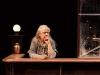
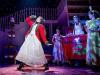
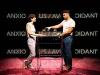
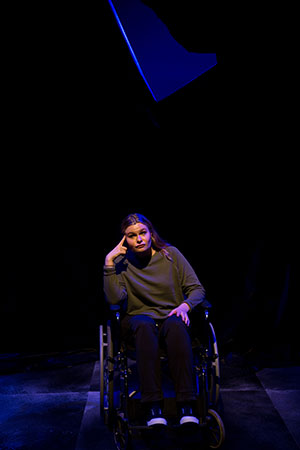
 Left – Jessica-Belle Keogh. Cover – Jeremy Waters and Skyler Ellis. Photos – Rupert Reid
When you’re stuck in an oppressively hot theatre with one fan struggling to make an impact during a Sydney heatwave, you’d better hope that the show you are about to see is good. Fortunately, this new British play manages to be both engrossing, unexpected, moving, and disarmingly funny, making the time virtually skip by.
The play begins as to all intents and purposes an example of the “verbatim theatre” genre, in which actors use texts assembled from the actual words of interviewed real people involved in a certain event or topic, and perform them as monologues. A kind of theatrical documentary, these speeches are typically juxtaposed and massaged into a context that imparts dramatic structure and flow, as well as a sense of narrative to the topic, much like editing together camera interviews.
Well, if verbatim theatre is equivalent to documentary film, that would presumably make BU21 the theatrical equivalent of a “mockumentary”, because even if one went into this play completely cold, any passing familiarity with current events would make you realise that they are talking about a major 9/11-type of event… which never actually happened. The monologues of these disparate characters caught up in this carnage eventually converge and intersect, and what at first appears to an almost random collection of stories ends up having more of an intertwined plot than you would expect from the stylistic format. Belatedly framed with some questionable metatheatrical flourishes, it is an assured piece of writing by a promising emerging playwright.
Outside of the play itself though, the notion of people emotively discussing the tragedy of an entirely made-up terrorist attack suddenly has a certain unfortunate topicality, given infamous “alternative facts” proffered in American politics over recent weeks over exactly such an invented incident. Of course the playwright, or even the producers of this local production, could not have possibly anticipated such an eventuality. But this coincidence, as well as the inherent topic of terrorism and Islamophobia, may possibly cause some to approach this play more warily than its content seemingly wants to be.
Which is, perhaps on a thematic level, arguably a flaw in the writing of what is on the whole a very good play. To give playwright Stuart Slade his due, the script does at least somewhat overtly engage with the issues of what can lead young Muslim men to be attracted to radicalised Islam, as well as the flipside of western bigotry and jingoistic backlash. Yet, as a text shot through with a surprising amount of humour whilst still being far from an actual comedy, the play does at times feel like it wants to have its cake and eat it too. For example, the text seemingly alludes to involvement in a potentially sinister political nationalist movement by the one character who has already shown the greatest propensity for racist populism, but the question is left unresolved in favour of finally showing him in a somewhat more sympathetic light.
And in the most grating example of the play’s occasional forays into meta-humour, a different character upbraids the audience for falsely jumping to a certain conclusion about a person’s political leanings, which the script had clearly been prompting us to mistakenly assume through context and intentionally misleading coincidences. This theatrical “misdirect” actually struck me as rather clever… that is, until the playwright felt the need to directly point it out using a fourth-wall-breaking mouthpiece. In general these “meta” flourishes appeared clumsy and indulgent, adding little to the play and ultimately seeming like smug overcompensations for a script that wasn’t actually lacking anything in terms of canny construction and intriguing ideas.
The play really is actually quite good on its own merits. Imagining the catastrophic crash of the titular passenger plane into a populated area of London after being shot down by homegrown terrorists armed with a missile launcher, we are introduced to six characters with different experiences of that terrible day. Converging in a survivor support group, we learn of their stories gradually, and through them gain a picture of the wider event, and how their personal journeys resonate with the wider British and international ripple that such a dramatic attack on one of the major cities of the western world would engender.
The characters are moderately diverse, quite vibrant, and all very interesting, although some more than others. Two of the female roles are unfortunately the least developed, yet both manage to have some very strong moments nevertheless. All the parts are filled, without exception, by some very strong local actors, with not a weak link in the chain, who present a range of British dialects with uniformly good accent work. Particular standouts were Bardiya McKinnon as Clive, a young man of Islamic heritage from an assimilated UK family, who struggles with his identity and faith in “War on Terror”-era England, and Jessica-Belle Keogh as Ana, a Romanian immigrant who survives with serious physical injuries in addition to the psychological ones shared by all the other characters to varying degrees.
Perhaps most notable, however, are the two least likable figures, both played with considerable charisma by the actors tackling these challenging roles. Jeremy Waters plays Graham, the aforementioned bigot who finds himself cast into the role of iconic national “hero”. He is a working-class Londoner who catalyses a resurgent post-Blitz-like indomitable British nationalism, after a chance on-the-spot interview amidst the destruction turns him into a celebrity. However, there are unexpected and darker undertones to his story, which make his character more complex than he first appears, and Waters injects the role with both a striking bluster and a sense of palpable moral terror.
Skyler Ellis fills the role of Alex, a posh young banker rendered by the disaster both temporarily homeless and notionally bereaved by the death of his girlfriend, but we quickly come to discover that he is slickly amoral, to the point of possible sociopathy. Sex-obsessed and emotionally manipulative, he explains with glee his discovery that support groups are a “target-rich environment” in which to “pull” vulnerable women, establishing quickly his profoundly loathsome character. Ellis is fortunately excellent in the role, as his part requires the actor to walk a tightrope between being completely unpalatable while also carrying the lion’s share of the comedy, via his outrageously callous and venal digressions.
Again, this betrays a bit of the playwright’s proclivities for savouring his gateaux of theatricality, as Alex’s use of comedy serves to offset what a truly awful person he clearly is, lest the audience turn on him completely, rather than actually make the character sympathetic in any meaningful way. This is something of a cheat, but perhaps a doubly necessary one, as Alex is also the vehicle for the aforementioned tics of meta-humour, occasionally functioning as the show’s de facto narrator. Alex prefaces some of his own monologues with jokes about the show’s structure and running time, and even directly chiding the audience as “perverts” for wanting to watch a play about such human misery. Although delivered by Ellis with an acerbic charm in keeping with the rest of his impressive performance, these touches come across as largely annoying, a bit “too clever by half”. Moreover, they are poorly integrated into an otherwise very strong text that does not seem much concerned with metatheatricality elsewhere.
BU21 is, although not without some scripting flaws, an excellent production of a highly engaging play, one which explores through fiction some all too real issues which sadly remain a contemporary reality.
Outhouse Theatre Co in association with The Old 505 Theatre presents
BU21
by Stuart Slade
Director Erin Taylor
Venue: The Old 505 Theatre, 5 Eliza Street, Newtown NSW
Dates: 8 February – 25 February 2017
Tickets: $40 – $30
Bookings: www.old505theatre.com
Visit: www.outhousetheatre.org